
Support at Home is the Australian Government aged care program that replaced Home Care Packages on 1 November 2025. It has been designed to make accessing help at home simpler, more flexible and more transparent, so you can live safely and comfortably in your home.
At HomeCaring, we’re here to help you understand what Support at Home means for you and make the transition easy. Whether you’re receiving aged care services now or exploring your options, we’ll work with you to create a personalised care plan that meets your needs.
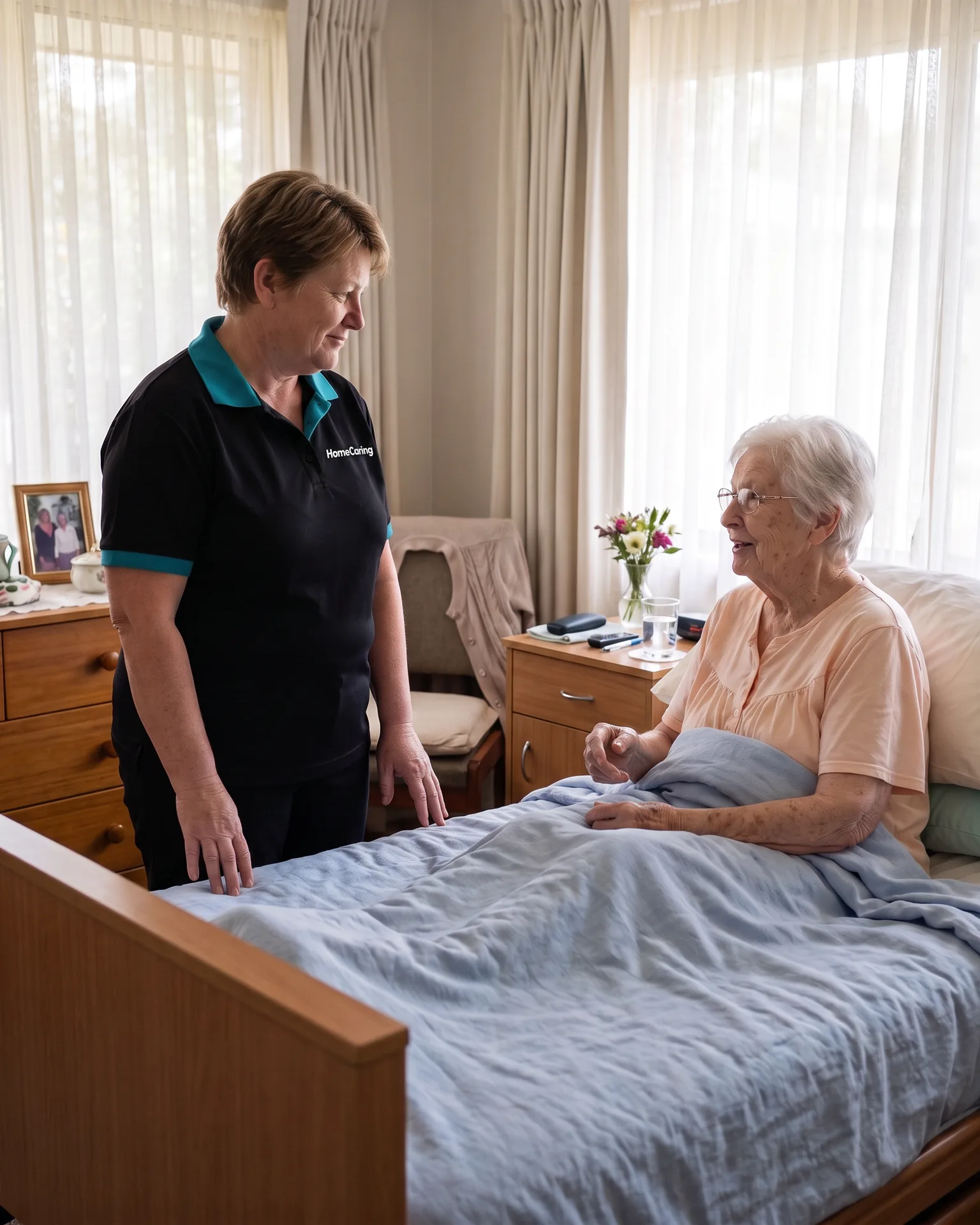
Support at Home is part of the Australian Government’s aged care reforms. It started on 1 November 2025, replacing the Home Care Packages (HCP) Program and the Short-Term Restorative Care Programme. The Commonwealth Home Support Program (CHSP) continues as a separate program, and the government has extended it to 30 June 2029.
The goal is simple: to give older Australians more choice and control over the care they receive and make it easier to get the right support at the right time. Support at Home funds ongoing care across eight classification levels, which replaced the four Home Care Package levels. It also has three short-term pathways. Learn more about the levels and how this change is designed to better match funding to your needs.
Key advantages of Support at Home:
Individualised funding based on assessed needs and managed through Services Australia
All eligible services are covered in one program
Single Assessment System using the Integrated Assessment tool for streamlined assessments
More transparency and consistency on pricing
Quarterly budgets, with unspent funds of up to $1,000 or 10% of your budget (whichever is higher) carried over
Pay-per-service model based on income and service type
Greater choice, meaningful options and defined service list
Three service categories: clinical supports, independence and everyday living
Target of a three-month wait by 2027 and 60% early funding if delayed
New pathways for Restorative Care and End-of-Life short-term and specialised support funding
You might be looking into support for the first time, waiting for funding or thinking about changing providers. Choose the situation that sounds most like yours to find a useful next step.
You can read every answer below, and you don't need to share contact details. This guide helps you find information, but it doesn't assess your eligibility or calculate funding.
If you're looking into aged care:
I'm looking into aged care for the first time
I'm approved for Support at Home and waiting for funding
My Support at Home funding is available, or I already receive services
I receive Commonwealth Home Support Program (CHSP) services
If you're looking into the NDIS or other options:
I'm exploring the National Disability Insurance Scheme (NDIS) for the first time
I already have NDIS funding
I'm considering private care, or I'm not sure
Thinking about changing providers? Compare your options in our Switch Hub.
My Aged Care is the government's starting point for aged care. An aged care assessment works out what support you may be eligible for.
You can check the requirements online or call My Aged Care on 1800 200 422.
Check if you can apply for an assessment
Support at Home is the government's in-home aged care program. It replaced Home Care Packages from 1 November 2025.
Being approved and getting your funding are two different stages. Your Notice of Decision letter explains what you're approved for and includes your support plan. How long you wait depends on your priority category and your approval date.
When your funding is allocated, you'll get a letter. You then have 56 days from the date of that letter to sign a service agreement and start services. If you need more time, you can ask My Aged Care for a 28-day extension.
While you wait, there are a few things you can do now to stay in control.
Start with a little private support. At HomeCaring, we offer private support now, so you can get help before your funding arrives. An hour or two a week of cleaning, transport or personal care can take some pressure off your family.
It also means your support is already in place when your funding starts. You pay for private support yourself, so ask your local team what it costs before you start.
Keep your My Aged Care details up to date. You can check your status in your My Aged Care Online Account. If a letter or your status isn't clear, call My Aged Care on 1800 200 422.
Ask for a support plan review if your needs change. If your health, mobility or daily tasks change while you wait, you can request a support plan review through My Aged Care.
Support at Home funding is released by priority, so if your needs are higher your funding may come sooner. A review can't promise a start date, but it keeps your plan up to date. Read when to ask for a support plan review.
Use the free support for carers. Family members often carry the most during the wait. Carer Gateway is one free government service, with counselling, respite and peer support for carers. You can call Carer Gateway on 1800 422 737.
Get ready for when your funding arrives. Think about the day-to-day support you'd like, and keep your referral code and assessment letters together. Take a look around your home for anything that makes daily tasks harder or less safe.
It also helps to start talking to providers now. That way, your allocation letter won't leave you rushing to decide.
Read what happens after approval
Have your funding letter, support plan and My Aged Care referral code nearby when you speak with a provider. Ask about the services you need, written prices and possible start dates.
If you had a Home Care Package, you now receive Support at Home. If you already receive care and want a change, our Switch Hub can help you compare your options.
The Commonwealth Home Support Program provides entry-level support to help you live independently at home. If you already receive CHSP services, keep using them while you wait for any other support.
At HomeCaring, we don't provide CHSP services. If you'd like extra help alongside them, we offer private support that you pay for yourself.
If your support no longer meets your needs, talk to your current provider or call My Aged Care on 1800 200 422. If your needs are more complex, an assessment may approve you for Support at Home instead.
Start with the NDIS eligibility requirements. You must be younger than 65 on the day you apply.
If you're aged 9 to 64, an NDIS partner can help you apply. Families of children younger than 9 can contact an early childhood partner. Anyone can also call the NDIS on 1800 800 110.
Read the NDIS eligibility requirements
Start with your goals and the support you want day to day. When you speak with a provider, ask how its supports fit your plan, what they cost and what's available in your area.
Ask for a service agreement that explains the supports, prices and how changes are handled. HomeCaring is a registered NDIS provider.
Talk to your local team about NDIS support
You don't need every answer before you ask a question. Tell your local team what you need help with and where you live, and ask for written prices before you decide.
At HomeCaring, we'll talk you through your options and what happens next. Reach out to our Care Specialists on 1300 875 377.
You’ll need an aged care assessment through My Aged Care to determine your care needs and funding
You’ll be given an individual budget based on your assessment, rather than a fixed package level
Together, we’ll create a personalised care plan that works for your lifestyle and goals
Your HomeCaring care team will coordinate services, monitor your progress and adapt support as your needs change
Support at Home services fall under three main categories:
Nursing, physiotherapy, occupational therapy No contributions required
Personal care, mobility aids, social support Contributions may apply. From 1 October 2026, personal care has no contribution
Cleaning, gardening, meal delivery Higher contributions apply
At HomeCaring, we’re here to make support simple, personalised and truly effective. Whether you need day-to-day help or high-level care, our local teams deliver care that’s designed around you. With HomeCaring, you’re supported by people who genuinely care and who show up for you.
Your local HomeCaring team is:
Registered nurses, support workers and coordinators with high-level care expertise
Care delivered to clinical and national quality standards
Support that respects your preferences, privacy and dignity
Flexible plans built around your goals, needs and support funding
Teams who understand your community and are there when you need them